

Robotics Engineering: A (Complete) Guide for Python Learners
Imagine a world where machines do more than just follow instructions. Imagine them perceiving their environment, making split-second decisions, and navigating complex terrains without human intervention.. It is the core of Robotics Engineering.
Robotics Engineering is the ultimate blend of mechanical prowess, electronic intelligence, and sophisticated software. At the heart of this revolution is a powerful tool: Python for robotics. This programming language has become the industry standard for developing everything from simple household bots to complex self-driving robots.
If you have ever wondered how a robot “thinks” or how a mechanical arm knows exactly where to move, you are looking at the result of thousands of hours of robot design and testing. In this guide, we will explore the foundations of this field and how you can prepare to enter a career that is literally building the future.
The demand for engineers who can navigate both the physical and digital worlds is skyrocketing. From healthcare to deep-sea exploration, autonomous robots are taking on roles that were once considered impossible. Let’s dive into what it takes to bridge the gap between imagination and reality.
Tomorrow Needs Computer Engineers Who Bridge the Gap

The modern world is increasingly reliant on embedded systems and intelligent hardware. We no longer just need people who can code or people who can weld. We need computer engineers who can do both. These are the professionals who bridge the gap between software and the physical world.
In the context of Robotics Engineering, this means understanding how a line of code translates into the movement of a motor. When working with Python for robotics, an engineer must understand how sensors feed data into a processor and how that processor then controls the robot’s actuators.
The gap also exists between theory and application. You might understand the mathematical formulas for kinematics, but applying them in a robotics lab is a different challenge. This requires a deep understanding of computer architecture and electrical circuits.
Tomorrow’s engineers must also be masters of connectivity. As we move toward the Internet of Things (IoT), robots need to communicate with each other and with the cloud. This requires a robust understanding of networking and data security. By focusing on this intersection, you become a versatile asset in any tech company.
Engineering Enterprise Concentration
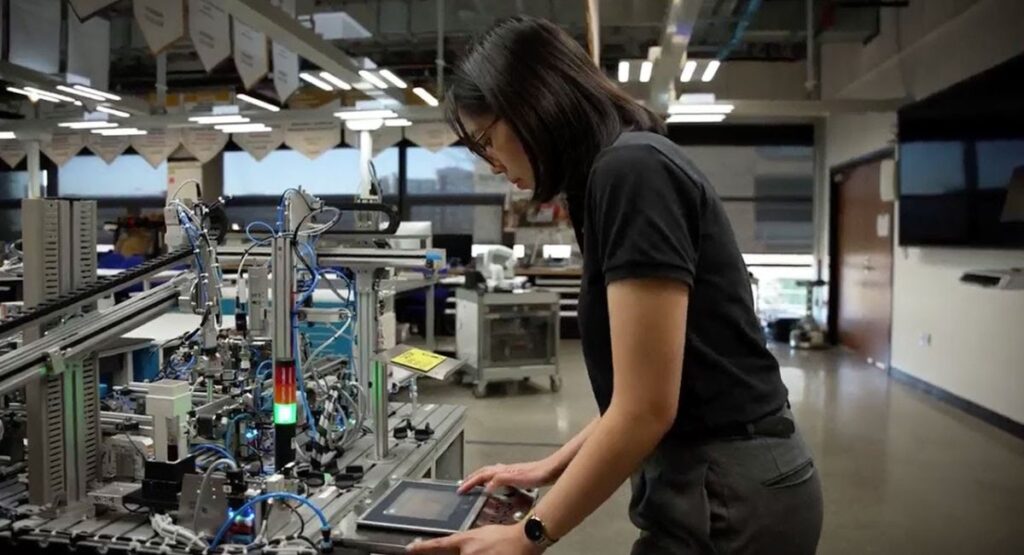
For those looking to excel in the field, moving beyond standard coursework is essential. An Engineering Enterprise concentration allows students and professionals to work on real-world projects that mimic the industrial environment. This is where you learn the business and collaborative side of robotics.
In an enterprise environment, you might be tasked with creating a fleet of self-driving robots for a warehouse. This isn’t just about the code. It involves project management, budgeting, and working across different engineering disciplines.
This concentration emphasizes the “design-build-test” cycle. You start with a concept for robot design. Then you build a prototype using CAD software and 3D printing. Finally, you take it into the robotics lab to see if it survives real-world stress.
Working in these enterprise-level groups prepares you for the high-stakes world of modern tech. You learn how to handle failure, how to iterate on your designs, and how to present your technical findings to people who may not be engineers.
Be Career Ready
Being “career ready” in the field of robotics means having a toolkit that is both broad and deep. While many languages exist, mastering Python for robotics is perhaps the most important step you can take. Python is used in ROS (Robot Operating System), which is the standard platform for robotics worldwide.
To be truly ready, you should also focus on autonomous robots. The industry is moving away from pre-programmed paths toward machines that can “see” and “react.” Understanding computer vision and machine learning will put you at the top of the candidate list.
Practical experience is non-negotiable. If you have access to a robotics lab, spend as much time there as possible. Building a simple robot that can navigate a maze is worth more than reading ten textbooks. It teaches you about sensor noise, battery management, and mechanical friction.
Networking and continuous learning are also vital. The field of Robotics Engineering changes every few months. Subscribing to journals and attending tech conferences keeps your skills sharp. Finally, soft skills like communication are key to explain complex technical calculations to stakeholders.
Department of Electrical and Computer Engineering

The foundation of any robotics journey usually starts in the Department of Electrical and Computer Engineering (ECE). This is where the magic happens. It is the academic home where the principles of electricity meet the logic of computing.
In a modern ECE department, the curriculum is designed to evolve. You start with the basics of circuits and digital logic. As you progress, you move into microcontrollers, signal processing, and eventually, the design of autonomous robots.
The labs within these departments are equipped with the latest technology. From high-speed oscilloscopes to robotic platforms, these tools allow you to experiment and push the boundaries of what is possible. It is here that you learn the rigors of scientific inquiry.
Faculty members in these departments often have ties to the industry. This means the theories you learn in the classroom are directly applicable to the challenges faced by companies today. It provides a structured path from being a curious student to a professional engineer.
What is Computer Engineering?
At its simplest, computer engineering is the branch of engineering that integrates electronic engineering with computer science. While a computer scientist might focus on the software, and an electrical engineer might focus on the hardware, the computer engineer lives exactly where they meet.
In the world of Robotics Engineering, this role is critical. Consider the following components that a computer engineer manages:
- Embedded Systems: These are the “brains” inside the robot.
- Hardware-Software Integration: Ensuring that code triggers the correct electrical signals.
- Signal Processing: Filtering out interference from sensors.
- System Architecture: Designing how sensors, motors, and processors communicate.
Key Skills for Robotics Engineers
Neeche di gayi table mein robotics engineering ke liye zaroori skills aur unke maqsad ko wazeh kiya gaya hai:
| Skill | Category | Importance in Robotics |
| Python Programming | Software | Industry standard for AI, ROS, and scripting. |
| CAD Design | Mechanical | Used for 3D modeling and robot design structure. |
| Linear Algebra | Mathematics | Essential for movement and rotation matrices. |
| Control Systems | Engineering | Helps in stabilizing robot movement and balance. |
| Computer Vision | Artificial Intelligence | Allows autonomous robots to “see” and identify objects. |
The Power of Python for Robotics
Why is Python the go-to language for this field? The answer lies in its simplicity and its massive library support. When you are designing autonomous robots, you don’t want to spend all your time worrying about memory management.
Python allows you to write high-level logic that is easy to read. Libraries like NumPy and SciPy handle mathematical lifting, while OpenCV allows visual processing. Furthermore, the Robot Operating System (ROS) has extensive Python support.
Essential Math for Robotics Engineering
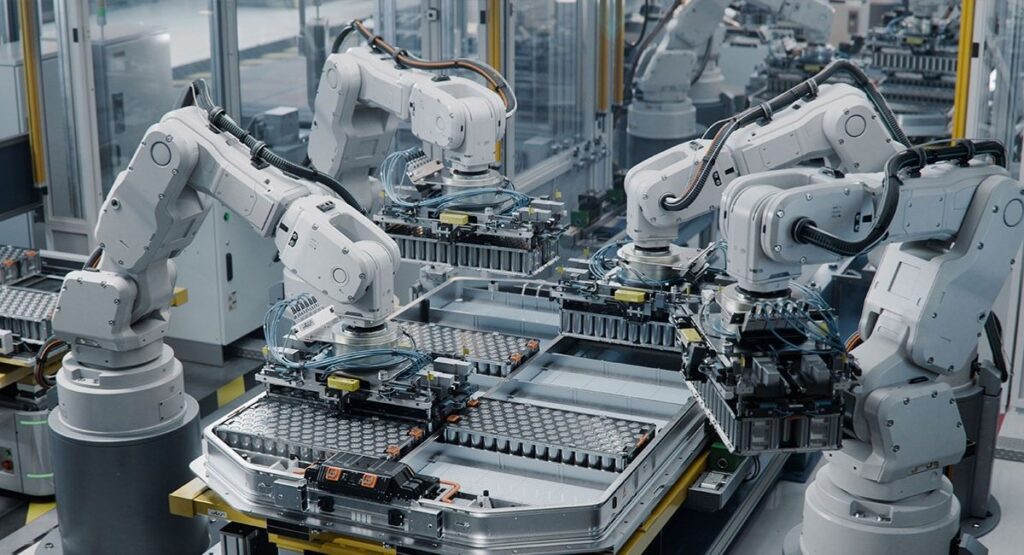
In robotics, we use linear algebra to describe position and orientation. A common calculation involves the rotation matrix. If we want to rotate a robot’s sensor by an angle $\theta$ around the Z-axis, we use the following:
$$R_z(\theta) = \begin{bmatrix} \cos\theta & -\sin\theta & 0 \\ \sin\theta & \cos\theta & 0 \\ 0 & 0 & 1 \end{bmatrix}$$
Frequently Asked Questions (FAQs)
1. Robotics Engineering shuru karne ke liye konsi programming language best hai?
Sabse behtareen language Python hai. “Python for robotics” is liye aam hai kyunke ise seekhna asaan hai aur is mein robotics ke liye boht saari libraries majood hain.
2. Kya mujhe robotics ke liye mahir mathematician hona zaroori hai?
Aapko basic calculus aur linear algebra ki samajh honi chahiye. Robotics mein “Technical calculations” matrices aur geometry par mabni hoti hain taake robot ki movement ko control kiya ja sake.
3. Autonomous robots aur remote-controlled robots mein kya farq hai?
Remote-controlled robots ko insan chalata hai, jabke autonomous robots apne sensors aur AI ka istemal kar ke khud faisle lete hain aur rasta talash karte hain.
4. Robot design mein sabse mushkil kaam kya hota hai?
Sabse mushkil kaam balance aur energy efficiency hai. Robot ko is tarah design karna ke woh kam battery mein zyada kaam kare aur mushkil raston par gire nahi, aik bara challenge hai.
Conclusion
Robotics Engineering is one of the most exciting and rewarding career paths in the 21st century. It offers the chance to work on the cutting edge of technology and solve some of the world’s most pressing problems. From self-driving robots to robotic prosthetics, the impact is profound.
By mastering Python for robotics and understanding the core principles of computer engineering, you position yourself at the center of this technological wave. The journey starts in the robotics lab, one line of code and one circuit at a time.